Electrostatic Precipitator (ESP) – importance, functioning & statutory requirements

  • Uses electrostatic charges to remove very fine solid particles, termed as suspended particulate matter (SPM) from gases/air
  • Micron size of such solid particles are harmful for all living beings, clogging their lungs while breathing-in from high SPM atmosphere.
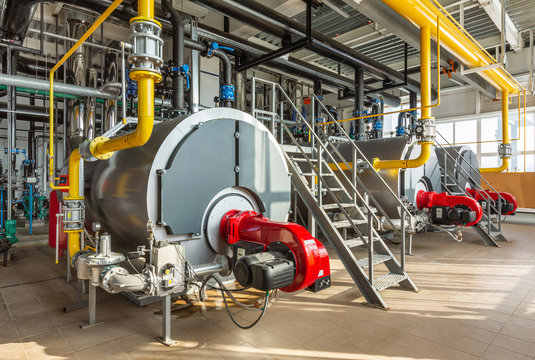
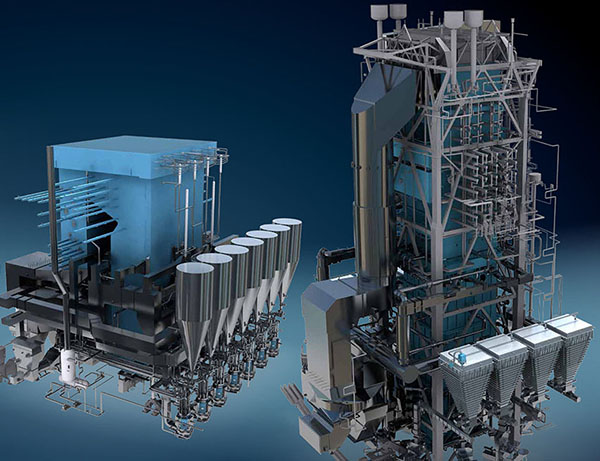
  • All kind of solid fuels fired combustion devices, like boilers, thermic fluid heaters, etc. do lead to some percentage of the unburnt tiny particles, thereby polluting our atmosphere.
Thermo Fab Engineers

Working Principle

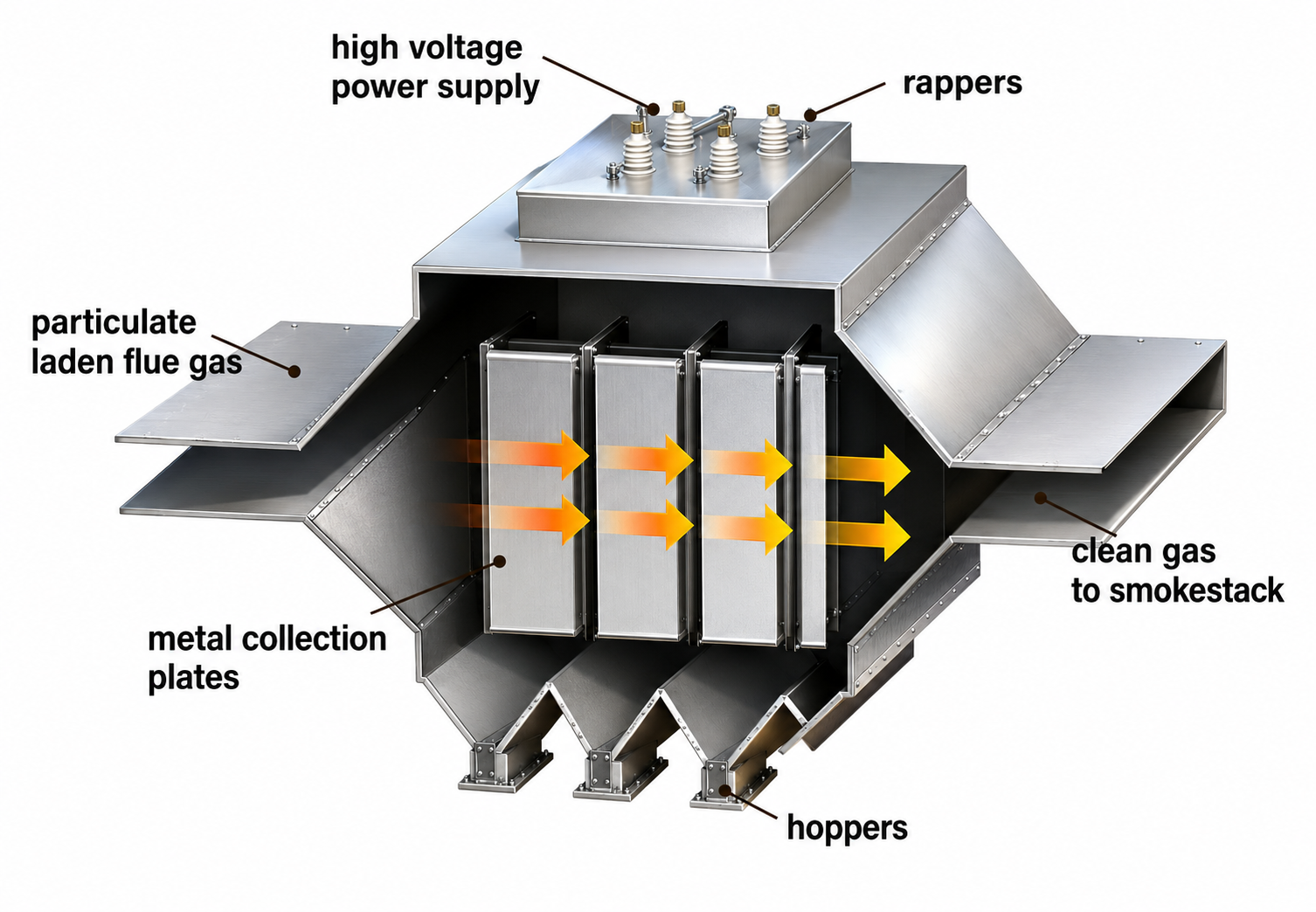
ESP involves high-voltage charge getting applied to the micron size tiny solid particles flowing in the flue gases, thereby attracting them to the opposite charged plates.

The device contains two sets of electrodes: negative electrodes (often wires or rods) and positive collector plates. As flue gas passes through the ESP, particles are ionized by the corona discharge from the negative electrodes, acquiring a negative charge. These charged particles are then attracted to the positively charged plates, where they accumulate and eventually fall due to gravity for collection. This process allows the ESP to remove particles efficiently while consuming minimal electrical energy, as energy is applied only to the particles not the gas itself.

ESPs can achieve up to 99% efficiency for particles 1.0 μm or bigger and theirperformanceremains high across a wide range of particle sizes. They are customizable to meet specific industrial requirements while using minimal electric power.

ISO 9001:2024

Certified quality management

Industry 4.0

Smart manufacturing & digital twins

Safety & Sustainability: Eco-friendly materials, energy-efficient designs, and rigorous NDT testing.

Thermo Fab Engineers - ESP Projects


S. No Customer FLUE GASES SOURCE Boiler Cap. Industry Boiler Fuel
1 Maruti Paper 50 TPH / 67 Kg/Cm² Paper Plant Multifuel
2 Siddeshwari Paper Mills 25 TPH / 67 Kg/Cm² Paper Plant Multifuel
3 Bhageshwari Paper Mills 45 TPH / 67 Kg/Cm² Paper Plant Multifuel
4 Siddharth Papers Ltd (ESP Retrofit) 50 TPH / 67 Kg/Cm² Paper Plant Multifuel
5 Garg Duplex Paper Mills 40 TPH Paper Plant Multifuel
6 Paswara Paper 14 TPH / 67 Kg/Cm² Paper Plant Baggase / Coal / Rice Husk
7 Hariom Industries Ltd 20 TPH / 10.5 Kg/Cm² Paper Plant Rice Husk / Coal
8 Ashoka Paper 25 TPH / 69 Kg/Cm² Paper Plant Rice Husk / Coal
9 Genus Paper Retrofit 55 TPH / 67 Kg/Cm² Paper Plant Rice Husk / Coal
10 Shakumbari Pulp & Paper Mills Pvt. Ltd. 12 TPH Paper Plant Baggase / Rice Husk
11 Janki News Print 55 TPH / 67 Kg/Cm² Paper Plant Rice Husk / Coal
12 Goel International 18 TPH / 67 Kg/Cm² Rice Mill Rice Husk
13 Sangal Papers Ltd. 24 TPH Paper Plant Wood Chips / Coal / Rice Husk
14 Gulshan Polyols Ltd. 90 TPH / 87 Kg/Cm² Distillery Indian Coal
15 Ashoka Kraft LLP (Assam) 35 TPH / 67 Kg/Cm² Paper Plant Rice Husk / Coal
16 Pragati Paper Industry Pvt. Ltd. 30 TPH / 63 Kg/Cm² Paper Plant Rice Husk / Coal
17 Gulshan Polyols Ltd. 40 TPH / 87 Kg/Cm² Distillery Indian Coal / Rice Husk
18 Silverton Pulp & Paper Ltd. 40 TPH / 46 Kg/Cm² Paper Plant Multifuel (RDF + Biomass + Mustard Husk)
19 Devrishi Papers Pvt. Ltd. 20 TPH / 21 Kg/Cm² Paper Plant RDF / Baggase / Biomass
20 Dev Priya Industries Pvt. Ltd. 62 TPH / 52 Kg/Cm² Paper Plant RDF / Mustard Husk / Rice Husk / Baggase / Wood Chips
21 ANSD Corporation LLP 50 TPH / 52 Kg/Cm² Paper Plant RDF / NRSW
22 Hariom Industries Ltd. 40 TPH / 52 Kg/Cm² Paper Plant RDF / Mustard Husk / Rice Husk / Baggase / Wood Chips
23 Uttaranchal Pulp & Paper Mills Pvt. Ltd. 15 TPH / 21 Kg/Cm² Paper Plant RDF / Rice Husk / Wood Chips
24 Solitaire Pulp & Paper Pvt. Ltd. (Mathura) 40 TPH / 52 Kg/Cm² Paper Plant RDF / Mustard Husk / Rice Husk / Baggase / Wood Chips
25 Anand Triplex Board Ltd. 70 TPH / 65 Kg/Cm² Paper Plant Rice Husk / RDF / Wood Chips
26 Silverton Pulp & Paper Ltd. 40 TPH / 60 Kg/Cm² Paper Plant RDF / Mustard Husk / Rice Husk / Baggase / Wood Chips
27 Silverton Pulp & Paper Ltd. 50 TPH / 60 Kg/Cm² Paper Plant Indian Coal / Rice Husk / Baggase / Wood Chips

Air Pollution Control

ESP:

ESP stands for Electrostatic Precipitator. This is a critical component for controlling air pollution. An ESP acts like a filter, specifically designed to target fine particles such as dust and smoke. These particles are a byproduct of the combustion process that happens within a boiler. There are several advantages to using an ESP in a boiler system. The most significant benefit is the reduction of harmful emissions. By capturing these fine particles, ESPs significantly contribute to cleaner air. This is especially important for ensuring boilers comply with air quality regulations. Another advantage is that ESPs are versatile. They function effectively with a variety of boiler fuels, including coal, oil, and even biomass. We have implemented numerous ESP across various plants, catering to both small and large-scale operations. For instance, in a 15 TPH boiler plant, we installed three field ESP units, optimizing the particulate matter filtration process. Conversely, for larger-scale operations like a 90 TPH plant, we engineered four-field ESP configurations, enhancing efficiency and ensuring stringent emission control standards are met.

SPECIFICATIONS

  • Power capacity: 5–600 MW
  • Gas temperature: Up to 350°C
  • Gas flow rate: 5–1500 m3/sec
  • Dust loading at ESP inlet: As per the site
  • Emission at ESP outlet: (<)10 mg/Nm3
  • Efficiency: 99.99%

Talk to us?

Call Us